MEGASESSION · Large-Volume Hair TransplantNot about how many we move,
Not about how many we move,
but making every follicle count
When extensive hair loss calls for moving a large number of follicles at once, what matters is not how many hairs are implanted but how many transplanted follicles survive. Motential performs large-volume transplants with fully non-incision FUE, focusing on just one patient a day.
That is why who does it, and how, is everything.
Director’s Note
Hello, I am Dr. Injae Lee of Motential, Cheongdam.
In practice, I often meet patients whose crown and front have thinned together and who need a large volume moved in one session. Many ask me to implant as much as possible at once. I completely understand. But to get straight to the point: in large-volume transplantation, what truly matters is not the number implanted but the number that survives.
The follicles in the donor area (back of the head) are a finite resource. Once taken, they are never replenished. So rather than pushing extraction volume, my principle is to move exactly what is needed, without waste, to where it looks most natural.
— Dr. Injae Lee, Director
About
What is a large-volume hair transplant (megasession)?
A procedure that moves a large number of follicular units in a single surgery is commonly called a megasession. It typically refers to transplanting about 3,000–6,000 follicular units in one session, and is considered for extensive hair loss — Norwood stages 5–7, where a wide area needs to be covered at once.
In a hair transplant, the relocated follicles connect to new blood vessels over 4-7 days in a process called graft survival. Only the follicles that complete this process well will grow for life. In other words, the more grafts you move at once, the harder and the more important it becomes to protect graft survival.
Just as important as the survival rate is design and placement. Which follicles to extract, and how to arrange and implant them, account for the most decisive part of the result.
Recommended
You may need this if
- You have thinning across both the crown and front and need to fill a wide area in one session (Norwood 5-7)
- Your hair loss has advanced significantly, making it hard to achieve the density you want with 2,000-3,000 grafts
- You want a large change in a single surgery rather than several separate sessions
- You need reinforcement because density looks insufficient after a past transplant (decided after checking donor-area condition)
That said, mega-session transplantation is not the right answer for everyone. Because the amount possible in one session depends on your donor follicle supply and scalp condition, we start by honestly explaining what range is realistically possible, based on a precise examination.
Key 01 · Survival
The real key - graft survival rate
Moving a lot of grafts is meaningless if they do not survive. A well-managed non-incision FUE mega-session is reported to achieve a follicle graft survival rate of roughly 93.5-96.6%, and one of the biggest variables driving that result is out-of-body time - how long the follicles stay outside the body.
One study reported that the longer the out-of-body time, the lower the survival rate, with follicle viability declining by roughly 1% per hour.
93.5–96.6%
Graft survival rate of a well-managed non-incision FUE mega-session
~1%
Viability loss per hour out of body
With more follicles to move, mega-session transplantation means longer surgery, so out-of-body time management and unhurried precision determine the result. This is exactly where Motential's approach shines.

How
How Motential performs mega-session transplantation safely
Motential has built the conditions these studies point to for protecting graft survival directly into its clinical system.
01
Keeping follicle out-of-body time short
We focus on just one patient a day. Because we never alternate between patients, extraction, storage, and implantation flow without interruption, reducing the time follicles stay outside the body.
02
Skilled teamwork
The director personally performs both extraction and implantation, while resident, skilled follicle technicians carry out precise separation under high-magnification microscopes at the same time. (No ghost surgery)
03
Minimal follicle damage
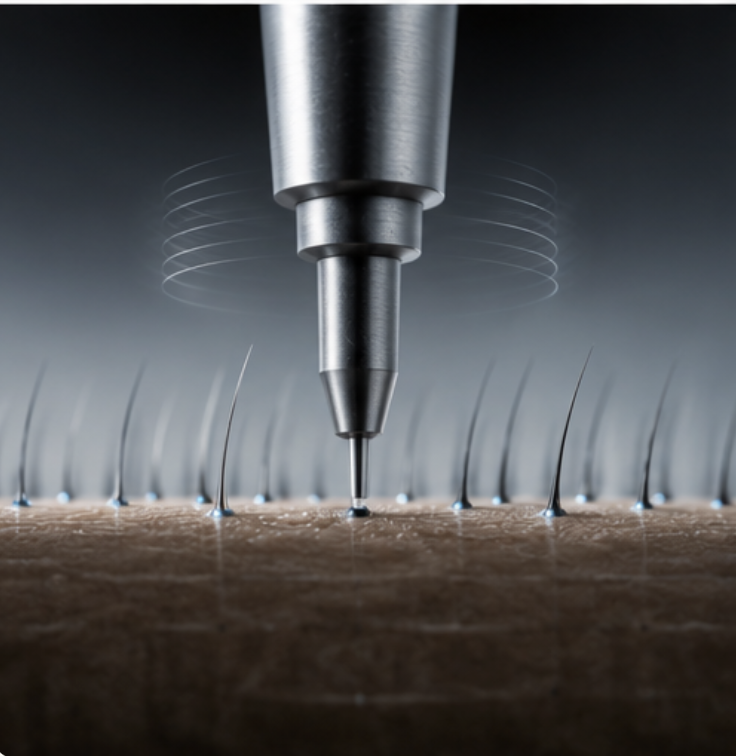
The Multiphasic Punch System finely controls rotation and vibration to reduce damage during extraction, and extracted follicles are immediately stored in organ-transplant-grade preservation solution to maintain a viable environment.
04
Precise calculation of donor-area resources
Using AFS3D combined with AI diagnostics, we analyze scalp and follicle condition and donor-area density to design the amount possible in one session and a waste-free placement.
05
Natural golden-ratio design
The wider the area, the more important it is to arrange the angle and direction of the hair to match a beautiful line. With the same hair count, where and how it is placed is what separates a transplanted look from a transplant that looks like it was always there.
06
Fast recovery
Because non-incision FUE extracts each fine follicular unit one by one, it leaves no linear scar, so a return to daily life is relatively fast even after a mega-session transplant.
Key 02 · Design
The real key - natural placement
As mentioned earlier, donor follicles are a limited resource that does not replenish. Extracting too many at once may look like a lot for now, but it can leave the donor area looking sparse, or leave too few follicles for later use if hair loss progresses further.
That is why my principle is not to move as many as possible, but to move exactly what you need now, into the most effective positions. Even if the graft survival rate is close to 100%, it is not a good result if the design and placement (implantation direction, angle, density distribution) look unnatural. Making the same hair count look fuller through placement - that, I believe, is the surgeon's skill.
Sometimes, rather than one ultra-large transplant, dividing it into stages or complementing density with SMP (scalp micropigmentation) is more natural and safer. What is right for you, I will tell you honestly after diagnosis.

At a glance
Procedure Summary
Method
Fully non-incision FUE · Non-shaven · Extraction and implantation performed by the director
Candidates
Extensive hair loss (Norwood 5-7, etc.) requiring many follicles at once
Transplant scale
Range of 5,000-10,000 grafts (maximum hair count varies by individual)
Surgery Time
6-12 hours; can be done over 2 sessions spaced 10-12 months apart
Anesthesia and Pain
Pain-relief systems such as AirNOX; performed without sedation
Recovery
Most patients can resume daily life the next day; early redness and scabbing subside within about 2 weeks
Final result
After temporary shedding (shock loss) around 1 month, growth starts from 3-4 months, with completion at 6 months to 1 year
Cost
Determined after consultation, depending on transplant scale
※ Non-covered fees are disclosed in advance. Results may vary depending on individual scalp condition, donor area, lifestyle, and other factors.
Aftercare
After surgery is the real beginning - one year of committed care
The larger the transplant, the more aftercare determines the result. Motential treats the year it takes for the result to settle in as a project we walk through together.
01
The Day After Surgery
We manage the first stage of recovery with shampoo service and disinfection.
02
Week 2
We support scalp recovery with low-level laser therapy and exosome injections.
03
Month 6 · Year 1
We check graft survival and progress with microscopic examination.
04
Home Care
We continue your care with home-care products and lifelong free prescriptions.
05
Guaranteed Reinforcement
Anything that falls short of expectations, we take responsibility for with reinforcement retouch after-care surgery.

Before / After
Extensive hair loss mega-session transplant cases
Before-and-after images
(posted after consent and review)
(posted after consent and review)
Before-and-after images
(posted after consent and review)
(posted after consent and review)
Before-and-after images
(posted after consent and review)
(posted after consent and review)
FAQ
Frequently Asked Questions
Q.Can you implant as many grafts as possible in one session?
The amount possible in one session depends on your donor follicle supply and scalp condition. Because over-extraction can lead to donor-area damage and reduced graft survival, we honestly explain the safe maximum after examination.
Q.Is mega-session transplantation safe?
The longer the surgery, the more important follicle out-of-body time management and precision become. Motential manages those conditions with one patient a day, preservation solution, and a skilled team. That said, your individual health condition needs to be checked at the consultation.
Q.Can it be done in one session, or does it need to be divided?
Many patients see a large change in a single session, but for very extensive cases, dividing it into 2 sessions can be more natural and safer. After diagnosis, we suggest the direction that fits you best.
Q.Do I need to shave my head? What about scars?
Because it is done as a non-shaven, non-incision FUE, no linear scar is left, and the extraction site retains only tiny dot-like marks that become unnoticeable over time.
Q.Who performs the surgery?
The director personally handles the entire process — consultation, diagnosis, design, extraction, implantation, and aftercare. No surgery is ever delegated.
Q.How long does recovery take?
Most patients can resume daily life the next day, and early redness and scabbing subside within about 2 weeks.
Medical Team
Dr. Injae Lee performs every surgery himself
From consultation and diagnosis to design and surgery to aftercare, the director takes part personally in every step. He adds an artistic sense to medical precision to design the most natural result.
- American Board of Hair Restoration Surgery (ABHRS) · International Board (IBHRS)
- Executive Director, Korean Society of Hair Restoration Surgery · Member, ISHRS
- Former director of NewHair Clinic - co-author of a hair transplantation textbook
- Featured on EBS, SBS, JTBC, MBN, tvN and more
Reservation
The wider the area, the more a single choice matters
The director diagnoses you personally and honestly explains what range is safely possible from the start. Leave a time that works for you, and we will consult with you one-on-one.
3F, Gallery JC Building, 415 Dosan-daero (Cheongdam-dong), Gangnam-gu, Seoul