ONE PATIENT A DAYOne patient a day,
One patient a day,
completed entirely
Motential operates on just one patient a day. In an awake (non-sedated) state, the director personally performs everything from extraction to implantation, start to finish. We never run several patients at once, nor swap people out midway.

Director’s Note
Patients often ask
Hello, I am Dr. Injae Lee, director of Motential Clinic in Cheongdam.
"Other places put you under sedation and let you sleep comfortably face-down while they work - why not here?" This is a question we often get during consultations. To put the conclusion first: the difference in surgical results between the two approaches is not large. I simply chose the safer, more honest approach - if the results are similar.
Hair transplantation is a surgery that can be done perfectly well with local anesthesia alone. So why do some places go out of their way to add deep sedation and have you lie face-down? On this page, I will honestly explain why, and why Motential insists on one patient a day, no sedation, and the director performing it personally.
Fair to say
The two approaches: the difference in results is not large
First, let me be fair. The quality of a hair transplant is determined not by the anesthesia method or position, but by who does it and how precisely. So, looking only at results, the difference between the two approaches is not large.
In other words, if the results are similar, what remains is a question of safety and trust. And here, I believe the answer is clear.
Awake by choice
That is why Motential chooses no sedation
Hair transplantation is a surgery that does not use general anesthesia. Deep sedation, too, adds risks you do not need to take on in a long surgery - respiratory suppression, blood-pressure changes, and more. Awake local anesthesia, by contrast, carries lower risk and, above all, lets you change position during surgery, check the hairline together, and see who is performing your procedure.
You may be worried about pain. That is why Motential reduces the discomfort of anesthesia with a pain-relief system (AirNOX and more), and manages the environment so you can be treated comfortably even while awake.
| No sedation - comfortable position Motential | Sedation - face-down position | |
|---|---|---|
| Anesthesia | Local anesthesia + no sedation (conscious) | Local anesthesia + deep sedation (asleep) |
| Surgical result | Difference is not large | Difference is not large |
| Safety | Low systemic risk | Requires managing respiratory and circulatory risk from sedation depth and long duration |
| Communication and confirmation | Awake, so position and line can be adjusted and the surgeon confirmed | Asleep, so no confirmation is possible |
Why it matters
In reality, anesthesia accidents have happened
Though very rare, accidents related to sedation (propofol and the like) during cosmetic and hair transplant surgery have in fact been reported. This is not meant to scare you, but to accurately let you know it is a risk you simply do not need to take on.
Depending on a patient's condition and drug response, sedatives can cause apnea, sudden drops in blood pressure, or a slowed heart rate — so a surgery lasting several hours demands especially close monitoring. My judgment is that there is no reason to add this risk to a procedure like hair transplantation, where local anesthesia alone is sufficient.
The real reason
Why do some clinics recommend 'asleep and face-down'?
Sometimes it is for patient comfort. But there are also structural reasons that deserve a hard look.
You cannot know who is operating
If you are asleep, you cannot know who is performing the procedure. What you could verify while awake, you have no way to verify under sedation.
It becomes easier to run several patients at once
With patients asleep and lying face-down, it becomes structurally easy for a doctor to step away or move between rooms.
In fact, proxy surgery ('ghost surgery') is a problem that has long been raised in Korean society. It even led to a law, in effect since 2023, allowing patients to request CCTV recording of the operating room for surgery under general anesthesia. I chose to make this concern structurally impossible in the first place.
Blocked at the source
How Motential eliminates this at the source
01
Awake, no sedation
You can see for yourself who is operating.
02
One patient a day
We never run several patients at the same time.
03
The director, personally
From extraction to implantation, no change of hands.
No rush
One patient a day — a promise not to rush
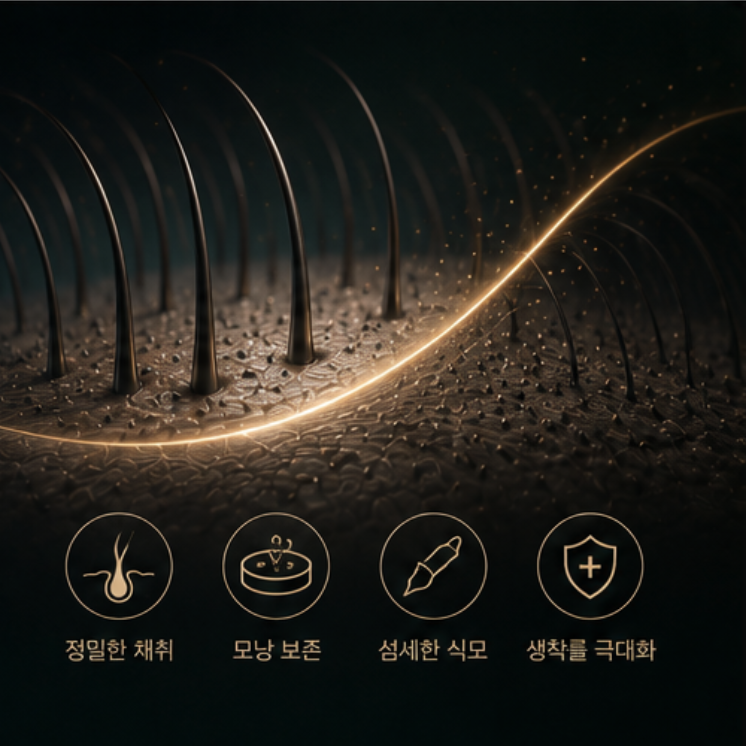
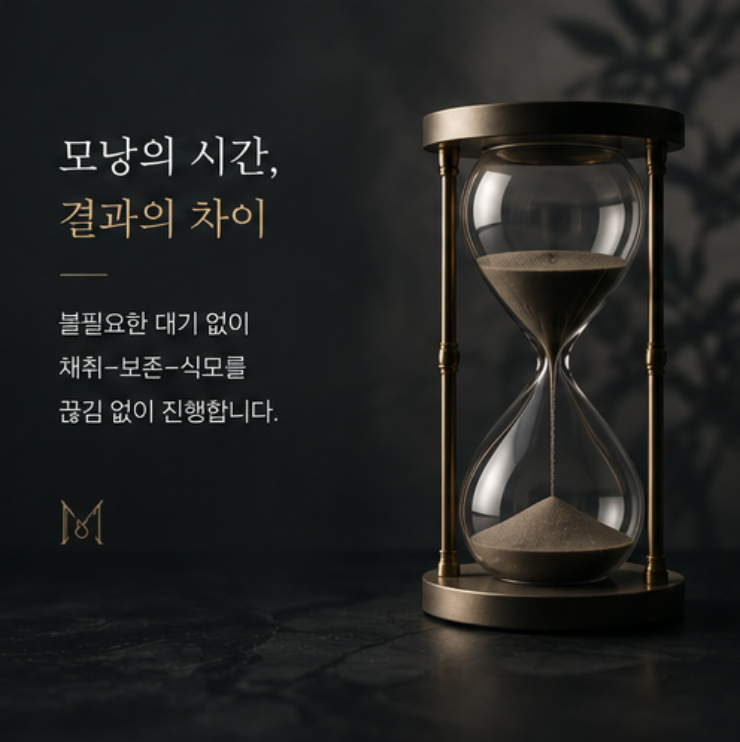
A hair transplant is precision work that takes hours, handling thousands of follicles one by one. Operating on several patients in a single day inevitably means rushing, and focus fades in the later stages. That is why I see only one patient a day.
- Unbroken focus — I focus on one patient alone, so the last follicle implanted matches the quality of the first.
- Managing follicles' time outside the body — Extraction, preservation, and implantation flow without interruption, protecting the graft survival environment of the transplanted follicles.
- The director, from start to finish — Consultation, design, extraction, implantation, and aftercare — one person is responsible for it all.
'One patient a day' is a principle that chooses quality of outcome over revenue. I treat each hair transplant as a work completed where medicine meets craft. One patient, wholly.
Before you choose
When choosing a clinic, be sure to check these
Whichever clinic you visit, we recommend asking the following.
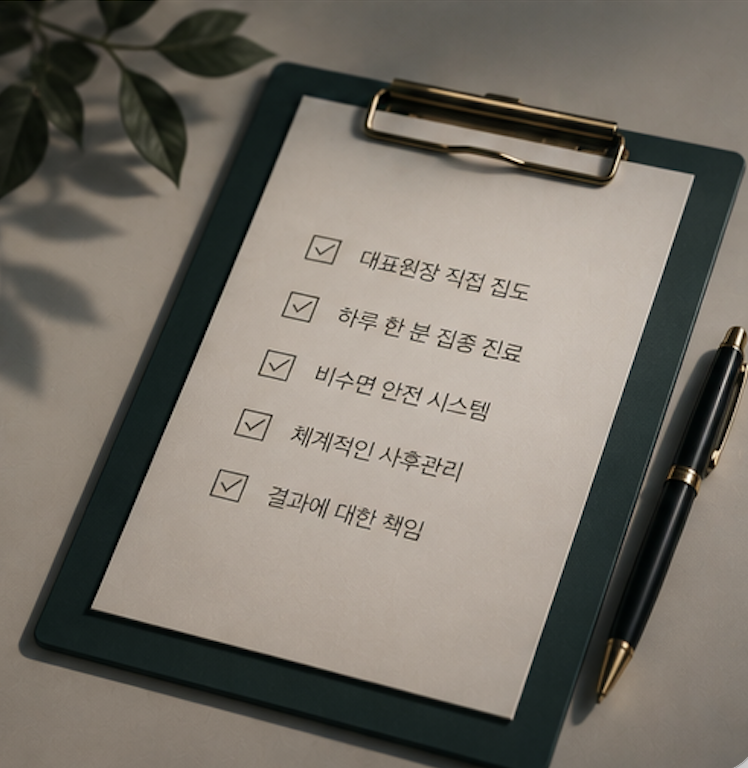
- Whether the director personally performs both extraction and implantation, with no change of hands midway
- How many patients are operated on per day (and whether several at once)
- Whether you can have the procedure while awake, or whether deep sedation is truly necessary
- Whether they provide materials to verify the result, such as a follicle-count certificate
FAQ
Frequently Asked Questions
Q.Isn't it more comfortable to sleep through it under sedation?
It can feel more comfortable. But hair transplantation is a procedure where local anesthesia alone is sufficient, so deep sedation adds risk that simply is not needed. At Motential, our pain-relief system keeps you comfortable while fully awake.
Q.Doesn't it hurt a lot without sedation?
Once the anesthesia takes effect, pain drops sharply. Our pain-relief system also eases the sting of the anesthetic itself, and most patients remain comfortable throughout the surgery.
Q.Isn't it done better lying face-down?
What matters more than position is precision and focus. Motential works in comfortable positions suited to each area, and adjusts your position as needed while you are awake.
Q.Are the results of the two approaches really similar?
Yes — the difference in the results themselves is not significant. Quality is determined less by anesthesia or position than by who performs the work and how precisely. That is why we chose our approach based on safety and trust.
Q.Who performs the surgery?
The director personally performs the entire process — consultation, design, extraction, implantation, and aftercare. It is an approach made possible by seeing only one patient a day.
Evidence · References
Compiled from the sources below as general information; individual results are not guaranteed. No specific medical institution is being singled out.
(1) Hair transplantation is typically performed under local anesthesia (with or without mild sedation); general anesthesia or deep sedation is generally not recommended due to higher respiratory and circulatory risks.
(2) Local anesthesia (awake) carries low systemic risk, and its cited advantages include the patient's ability to adjust position, check the hairline, and communicate with the medical team during surgery.
(3) Proxy surgery (ghost surgery) has been a publicly raised issue in Korea; under the revised Medical Service Act in effect since 2023, patients may request CCTV recording of the operating room for surgery under general anesthesia.
Reservation
One patient a day, wholly.
You stay awake — and the director personally completes your surgery, from start to finish.
3F, Gallery JC Building, 415 Dosan-daero (Cheongdam-dong), Gangnam-gu, Seoul