두피문신 vs 모발이식 결정하는 기준은?頭皮文身 vs 植毛、決める基準は?Scalp Micropigmentation vs Hair Transplant: How to Decide?

두피문신 vs 모발이식 결정하는 기준은?
안녕하세요, 청담 모텐셜의원 이인재 원장입니다.
탈모로 고민인데, 두피문신과 모발
이식 수술 두 가지 중 어떤 게 나에게 맞는지 판단하기 어려우신가요?
사실 당연한 고민입니다. 이 부분에 대해 검색을 해 보아도 정확한 정보를 찾기 어렵죠. 요즘은 대부분이 광고, 상위노출을 위해 기계적으로 쓰여진 글뿐이라,
“우리가 좋아요. 잘해요.”
라는 단순한 주장만 담긴 글들이 검색창의 상당 부분을 차지하고 있습니다.
두피문신 시술과 모발이식 수술을 모두 직접 진행하는 입장에서, 최근 연구 자료를 근거로 정리해 드리겠습니다.
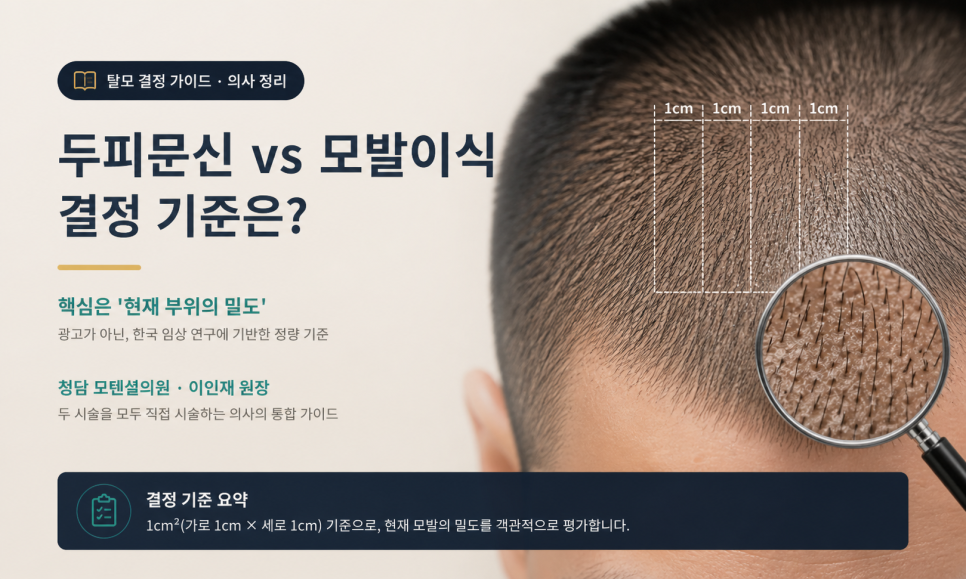
알기쉽게 결론부터 말씀드리자면 ‘고민 부위의 밀도’가 핵심입니다
일정 수치 이상으로 밀도가 높다면 두피문신 시술을 더 추천드리고, 그보다 밀도가 낮다면 모발이식 수술을 추천드립니다.
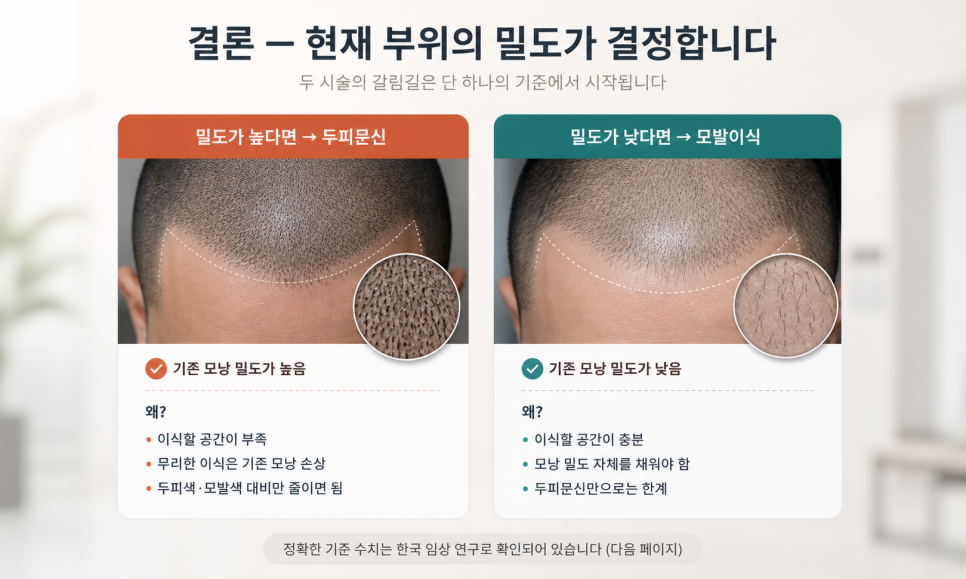
이 한 줄이 오늘 글의 핵심입니다. 왜 이렇게 되는지를 이제 풀어드리겠습니다.
1. 모발이식은 ‘모낭이 이사가는 것’
모발이식 수술은 간단히 말하면, 후두부의 모낭을 헤어라인이나 정수리로 옮겨 심는 수술입니다.
후두부의 모낭은 한 번 채취하면 더 이상 그곳에선 나지 않기 때문에, 완전히 이사를 가는 셈이죠.
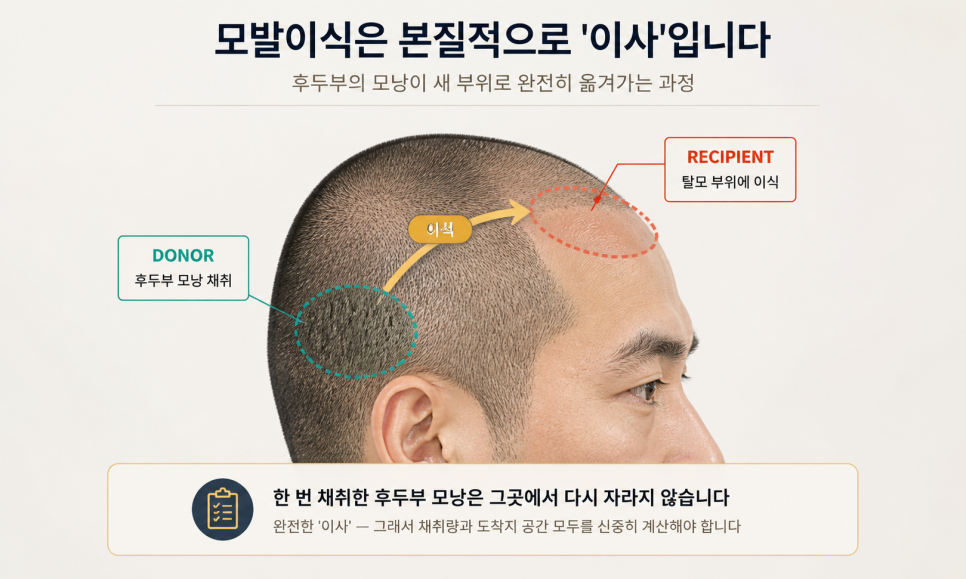
이때 먼저 확인할 부분은, 이사 갈 곳에 새로운 모낭이 들어가서 자랄 수 있는 공간이 충분한지입니다.
이미 기존의 모낭이 높은 밀도로 자리 잡고 있다면, 무리하게 새로운 모낭을 이식했을 때 두 가지 문제가 발생합니다.
첫째, 기존 모낭이 손상을 받을 수 있습니다.
둘째, 새로 이식된 모낭의 생착이 어려워질 수 있습니다.
둘 다 환자분에게는 안 좋은 결과입니다.
2. 다만 한 가지 예외가 있습니다 — 연모화
여기서 예외 케이스가 하나 있습니다.
기존 모낭이 높은 밀도로 자리 잡고 있지만, 탈모가 많이 진행되면서 그 모낭들이 많이 퇴화되었고, 모낭이 만들어내는 머리카락 역시 하나하나가 너무 연모화되어 솜털처럼 남아있다면 어떨까요?
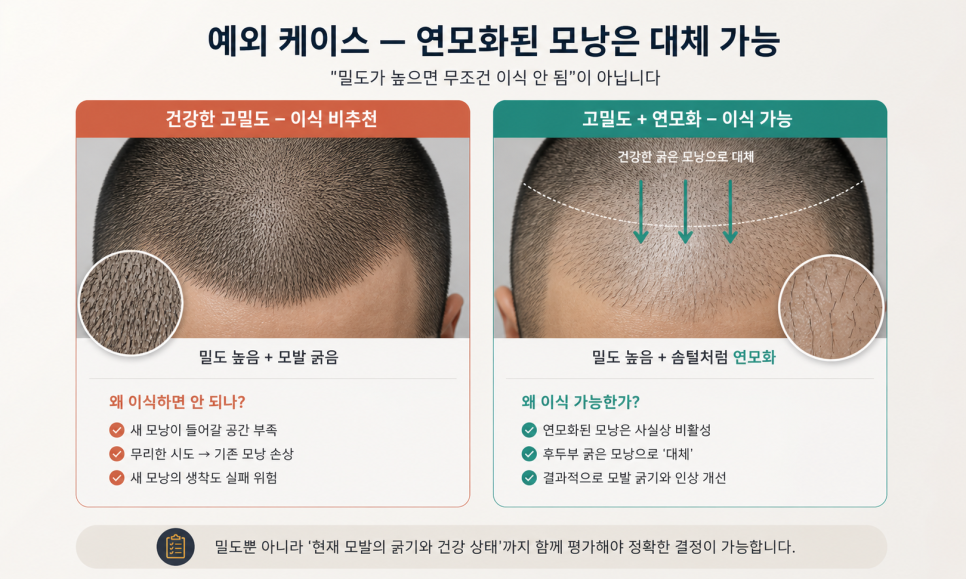
그땐 후두부에서 이사 오는 건강한 모낭이 만들어내는 머리카락의 굵기가 훨씬 좋다는 가정 아래, 그 연모화된 모낭을 대체하는 목적으로 모발이식을 시도해 볼 수 있습니다.
즉, “밀도가 높으니까 무조건 이식 안 됨”이 아니라, 현재 모발의 굵기와 건강 상태까지 함께 봐야 한다는 뜻입니다.
3. 그렇다면 모발이식이 적합한 밀도의 기준은?
이와 관련된 흥미로운 연구가 있습니다.
한국에서 진행된 이 연구에 따르면, 1제곱센티미터당 104.6개 이상의 머리카락이 있으면 두피문신의 만족도가 높았고, 96.17개보다 적게 있는 경우엔 모발이식 수술의 만족도가 높았다고 합니다.
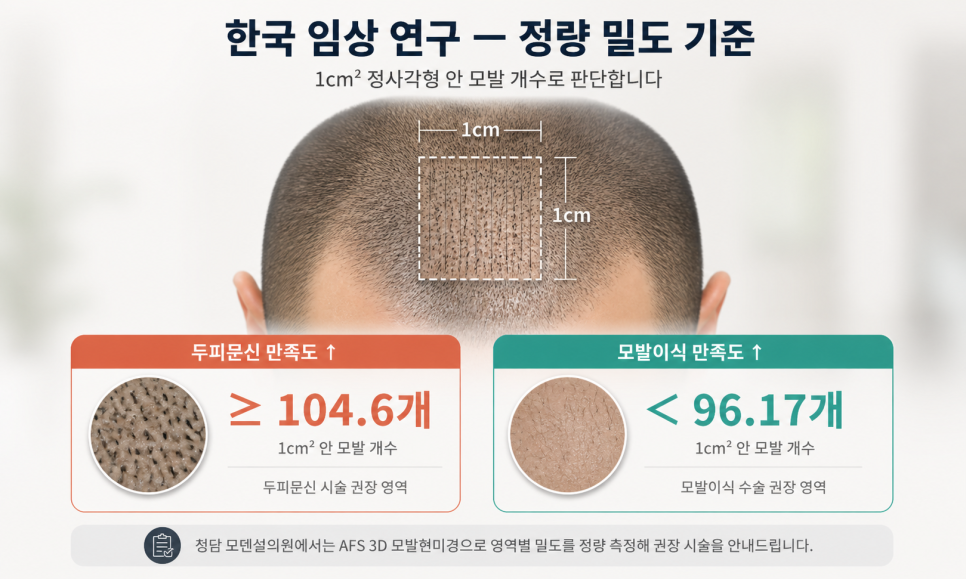
다시 말해, 모발이식 수술과 두피문신 시술을 결정하기 전에 현미경 검사를 통해 가로세로 각각 1cm 정사각형 안에 몇 개의 모발이 있는지 밀도를 측정해 본다면, 훨씬 현명한 선택에 도움이 될 수 있습니다.
청담 모텐셜의원에서는 AFS 3D 모발현미경으로 환자분의 두피 영역별 밀도를 ai가 정량적으로 측정한 뒤, 이 기준을 바탕으로 두 시술 중 어떤 방향이 적합한지 대표원장인 제가 직접 상담드리고 있습니다.
4. 두피문신은 짧은 머리만 받는 시술이 아니다?
여기서 중요한 오해 한 가지를 짚어드리고 싶습니다.
“두피문신은 짧은 머리, 삭발한 사람만 받는 시술이다”라는 인식이 많은데, 이건 절반만 맞는 이야기입니다. 실제로 진료실에서 만나는 두피문신 적응 케이스는 다음과 같이 다양합니다.
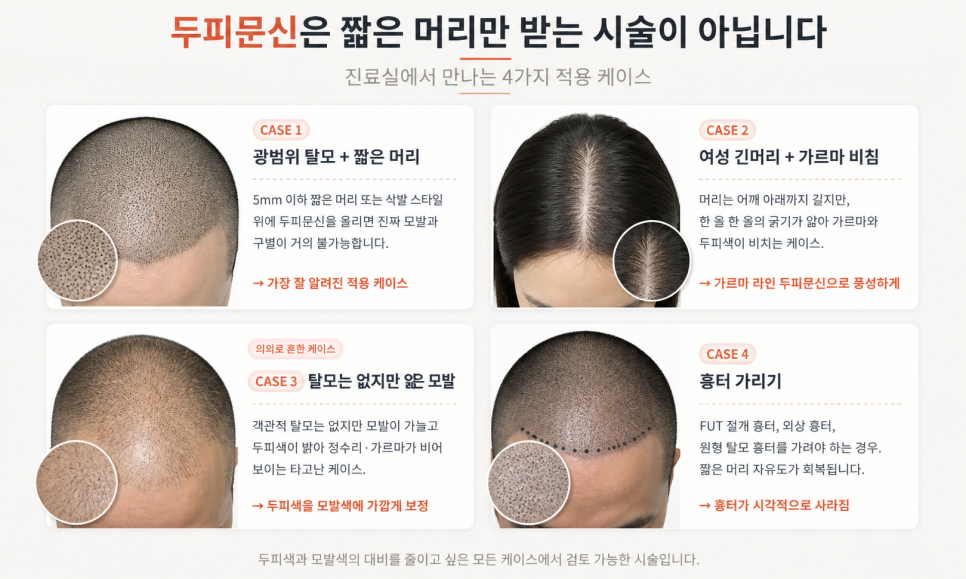
첫째, 광범위 탈모 + 짧은 헤어 스타일. 가장 많이 알려진 케이스입니다. 5mm 이하 짧은 머리 위에 두피문신을 올리면 진짜 모발과 구별이 거의 불가능합니다.
둘째, 여성 탈모. 머리카락은 질고 모발의 밀도는 높지만, 모발 한 올 한 올의 굵기가 얇아 가르마 두피가 비쳐 보이는 경우입니다. 이런 분들은 가르마 라인을 따라 두피문신을 진행하면 두피가 비치는 것이 시각적으로 사라져, 풍성한 머리숱으로 보이게 됩니다.
셋째, 탈모가 전혀 없지만 타고난 얇은 모발. 객관적인 탈모는 진행되지 않았는데도 모발이 가늘고 두피색이 밝아 정수리·가르마 부위가 비어 보이는 케이스입니다. 의외로 진료실에 자주 오시는 케이스이고, 이때도 두피문신이 두피색을 모발색에 가깝게 만들어 시각적 풍성함을 만들어 줍니다.
넷째, 흉터 가리기. 과거 FUT 절개 흉터, 외상 흉터, 원형 탈모 흉터를 가려야 하는 경우 두피문신이 가장 효과적입니다. 흉터 위에 모낭과 동일한 색·크기의 점을 새기면 흉터가 시각적으로 사라집니다.이 경우엔 드물게 선을 그어 커버하기도 합니다.
이렇게 두피문신은 머리 길이나 탈모 정도와 무관하게, ‘두피색과 모발색의 대비를 줄이고 싶은 모든 케이스’에서 검토 가능한 시술입니다.
5. 모발이식이 정답인 케이스
모발이식이 명확히 더 나은 결과를 주는 경우입니다.
첫째, 1cm²당 96개 미만의 부분 탈모(M자, 가르마, 정수리)로 이식할 공간이 충분하고, 기존 모낭과의 충돌 위험이 낮은 케이스입니다.
둘째, 만질 수 있는 진짜 모발을 원하실 때. 두피문신은 어디까지나 시각적으로 ‘착시 효과’ 이며 실제 볼륨감이 늘어나지 않습니다.
셋째, 자연스럽고 다양한 스타일의 헤어라인 디자인이 핵심일 때. 이마 헤어라인은 한 사람의 인상을 결정하는 가장 중요한 부위이고, 입체적인 헤어 라인은 모발이식만이 만들 수 있습니다.
넷째, 영구적 결과를 원하실 때. 모발이식 모낭은 평생 자라지만, 두피문신은 3-5년 주기로 리터치가 필요합니다.
6. 둘 다 함께 진행하는 게 가장 좋은 케이스
저희 병원에서 특별하게 많이 진행하는 케이스가 사실 이 조합입니다. 수술과 시술 모두를 의사가 직접 진행하는 병원이 드물기 때문입니다.
첫째, 헤어라인은 모발이식으로 더 집중적으로 이식해 실제 모발의 입체감을 만들고, 후두부·정수리 광범위 영역은 사이사이 공간을 찾아 굵은 모낭단위 위주로 이식을 하되, 부족한 부분은 두피문신으로 풍성함을 보완하는 케이스입니다. 후두부 모낭이 부족한 경우 그 한계를 영리하게 극복하는 방법입니다.
둘째, 과거에 받은 모발이식 후 재수술이 어려운 상황에서 밀도가 아쉬운 부위에 두피문신을 추가하면, 두피색 노출이 줄어들면서 시각 밀도가 약 두 배로 올라가는 그림자 효과가 발생합니다.
셋째, 과거 두피에 생긴 흉터에 가능하다면 소량의 모발이식을 진행한 뒤 두피문신을 병행하는 케이스.
그 외 고려해야 할 변수들
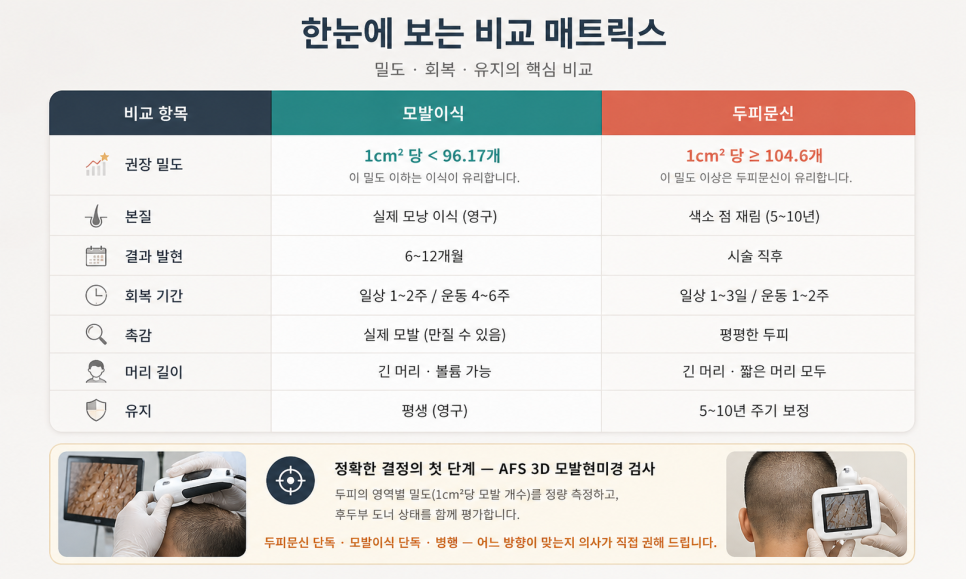
물론 모발이식 수술과 두피문신 시술을 선택하는 데 있어선 환자분 각자의 디테일한 니즈가 반영되어야 하고, 비용이나 여유 시간 등 현실적인 부분들도 고려해야 하며, 채취할 후두부의 모낭 상태와 채취 가능량까지 변수가 많습니다.
다만 “둘 다 의학적으로 가능하다고 보았을 때 어떤 것이 더 효과적일지”에 대한 고민이라면, 오늘 정리해 드린 밀도 기준이 가장 객관적이고 신뢰할 만한 출발점이 됩니다.
마무리
탈모로 고민하시면서 인터넷 검색에 시간을 많이 쏟고 계신 분들이 진료실에 자주 오십니다. 그 시간이 안타까운 이유는, 광고 위주의 글을 아무리 읽어도 본인에게 맞는 답이 나오지 않기 때문입니다.
가장 정확한 답은 단순합니다. 본인의 두피를 병원에서 정밀 검사 받아보시는 것입니다. AFS 3D 모발현미경으로 영역별 밀도(1cm²당 모발 개수)를 측정하고, 후두부 모발 상태를 확인하면 두피문신 단독, 모발이식 단독, 또는 두 가지 병행 중 어느 방향이 맞는지 의사가 직접 권해 드릴 수 있습니다
.
오늘 글이 결정에 도움이 되셨기를 바랍니다. 더 궁금하신 부분이 있으시면 언제든 진료실에서 편하게 말씀 주세요.
청담 모텐셜의원 이인재 드림.
頭皮文身 vs 植毛、決める基準は?
こんにちは、清潭モテンシャル医院のイ・インジェ院長です。
薄毛にお悩みで、頭皮文身と植毛、
この二つの手術のうち、どちらが自分に合うか判断が難しいと感じていませんか?
実はもっともなお悩みです。この点について検索しても、正確な情報を見つけるのは難しいものです。最近は大半が広告や上位表示のために機械的に書かれた記事ばかりで、
「うちが良いですよ。上手ですよ。」
という単純な主張だけの記事が、検索結果のかなりの部分を占めています。
頭皮文身の施術と植毛手術の両方を自ら手がける立場から、最新の研究資料をもとに整理してお伝えします。
わかりやすく結論からお伝えすると、「お悩みの部位の密度」が核心です
一定の数値以上に密度が高ければ頭皮文身の施術をおすすめし、それより密度が低ければ植毛手術をおすすめします。
この一文が今日の記事の核心です。なぜそうなるのかを、これから解きほぐしてお伝えします。
1. 植毛は「毛包の引っ越し」
植毛手術を簡単に言うと、後頭部の毛包をヘアラインや頭頂部へ移し植える手術です。
後頭部の毛包は一度採取すると、その場所からはもう生えてこないため、完全に「引っ越し」をすることになります。
このときまず確認すべきなのは、引っ越し先に新しい毛包が入って育つだけの空間が十分にあるかどうかです。
すでに既存の毛包が高い密度で定着している場合、無理に新しい毛包を移植すると、二つの問題が起こります。
一つ目、既存の毛包が損傷することがあります。
二つ目、新しく移植した毛包の生着が難しくなることがあります。
どちらも患者さまにとって良くない結果です。
2. ただし一つだけ例外があります — 産毛化
ここで例外のケースが一つあります。
既存の毛包は高い密度で残っているものの、薄毛が進んでその毛包が大きく退化し、毛包がつくる髪も一本一本が産毛のように細くなって残っている場合はどうでしょうか?
その場合は、後頭部から移ってくる健康な毛包がつくる髪のほうが太くて状態が良いという前提で、その産毛化した毛包を置き換える目的で植毛を試みることができます。
つまり、「密度が高いから絶対に移植できない」ではなく、今の髪の太さと健康状態まで一緒に見る必要がある、ということです。
3. では、植毛が適した密度の基準は?
これに関する興味深い研究があります。
韓国で行われたこの研究によると、1平方センチメートルあたり104.6本以上の髪があると頭皮文身の満足度が高く、96.17本より少ない場合は植毛手術の満足度が高かったとされています。
言い換えれば、植毛手術や頭皮文身の施術を決める前に、顕微鏡検査で縦横それぞれ1cmの正方形の中に何本の髪があるか密度を測ってみれば、はるかに賢い選択の助けになります。
清潭モテンシャル医院では、AFS 3D毛髪顕微鏡で患者さまの頭皮の部位ごとの密度をAIが定量的に測定したうえで、この基準をもとに二つの施術のどちらが適しているかを、代表院長である私が直接ご相談しています。
4. 頭皮文身は短髪の人だけが受ける施術ではない?
ここで、よくある重要な誤解を一つ取り上げたいと思います。
「頭皮文身は短髪や坊主の人だけが受ける施術だ」という認識が多いのですが、これは半分だけ正しい話です。実際に診察室で出会う頭皮文身の適応ケースは、次のように多様です。
一つ目、広範囲の薄毛+短いヘアスタイル。最もよく知られたケースです。5mm以下の短い髪の上に頭皮文身をのせると、本物の毛とほとんど見分けがつきません。
二つ目、女性の薄毛。髪は長く密度も高いものの、一本一本の太さが細く、分け目の頭皮が透けて見える場合です。こうした方は分け目のラインに沿って頭皮文身を行うと、頭皮の透けが視覚的に消え、ボリュームのある髪に見えるようになります。
三つ目、薄毛はまったくないが、生まれつき髪が細い方。客観的な薄毛は進んでいなくても、髪が細く頭皮の色が明るいために、頭頂部や分け目が空いて見えるケースです。意外と診察室によくいらっしゃるケースで、この場合も頭皮文身が頭皮の色を髪の色に近づけ、視覚的なボリュームをつくります。
四つ目、傷あと隠し。過去のFUT切開の傷あと、外傷の傷あと、円形脱毛の傷あとを隠す必要がある場合、頭皮文身が最も効果的です。傷あとの上に毛包と同じ色・大きさの点を刻むと、傷あとが視覚的に消えます。この場合、まれに線を引いてカバーすることもあります。
このように頭皮文身は、髪の長さや薄毛の程度に関係なく、「頭皮の色と髪の色のコントラストを減らしたいすべてのケース」で検討できる施術です。
5. 植毛が正解のケース
植毛が明らかにより良い結果をもたらす場合です。
一つ目、1cm²あたり96本未満の部分的な薄毛(M字・分け目・頭頂部)で、移植する空間が十分にあり、既存の毛包との衝突リスクが低いケースです。
二つ目、触れられる本物の髪を望むとき。頭皮文身はあくまで視覚的な「錯視効果」であり、実際のボリュームが増えるわけではありません。
三つ目、自然で多様なスタイルのヘアラインデザインが核心のとき。額のヘアラインはその人の印象を決める最も重要な部位で、立体的なヘアラインは植毛だけがつくれます。
四つ目、半永久的な結果を望むとき。植毛した毛包は一生育ちますが、頭皮文身は3〜5年ごとにリタッチが必要です。
6. 両方を併せて行うのが最も良いケース
当院で特に多く行うケースが、実はこの組み合わせです。手術も施術も医師が自ら行うクリニックがまれだからです。
一つ目、ヘアラインは植毛でより集中的に移植して実際の毛の立体感をつくり、後頭部・頭頂部の広い領域はすき間を探して太い毛包単位を中心に移植しつつ、足りない部分は頭皮文身でボリュームを補うケースです。後頭部の毛包が足りない場合に、その限界を賢く乗り越える方法です。
二つ目、過去に受けた植毛の後、再手術が難しい状況で、密度が物足りない部位に頭皮文身を加えると、頭皮の色の露出が減り、視覚的な密度が約2倍に上がる「影効果」が生まれます。
三つ目、過去に頭皮にできた傷あとに、可能であれば少量の植毛を行ったうえで頭皮文身を併用するケース。
その他、考慮すべき要素
もちろん、植毛手術と頭皮文身の施術を選ぶにあたっては、患者さまそれぞれの細かなニーズが反映されるべきですし、費用や使える時間といった現実的な部分も考慮しなければならず、採取する後頭部の毛包の状態や採取可能量まで、変数は多くあります。
ただ、「どちらも医学的に可能だと考えたうえで、どちらがより効果的か」というお悩みであれば、今日整理してお伝えした密度の基準が、最も客観的で信頼できる出発点になります。
おわりに
薄毛に悩みながらネット検索に多くの時間を費やしている方が、よく診察室にいらっしゃいます。その時間がもったいないのは、広告中心の記事をいくら読んでも、ご自身に合う答えが出てこないからです。
最も正確な答えはシンプルです。ご自身の頭皮を病院で精密検査することです。AFS 3D毛髪顕微鏡で部位ごとの密度(1cm²あたりの本数)を測り、後頭部の毛の状態を確認すれば、頭皮文身単独・植毛単独・あるいは両方の併用のどの方向が合うかを、医師が直接おすすめできます。
.
今日の記事がご決断のお役に立てば幸いです。さらに気になる点があれば、いつでも診察室でお気軽にお話しください。
清潭モテンシャル医院 イ・インジェ 拝
Scalp Micropigmentation vs Hair Transplant: How to Decide?
Hello, I am Dr. Injae Lee, head doctor of Motential Clinic in Cheongdam.
You are worried about hair loss, but is it hard to judge which of the two — scalp micropigmentation or hair-transplant
surgery — suits you?
It is a natural worry. Even if you search on this, accurate information is hard to find. These days most of it is just advertising, articles written mechanically for top search ranking, so
“We’re good. We do it well.”
— articles containing only such simple claims take up a large part of the search results.
As someone who performs both scalp micropigmentation and hair-transplant surgery myself, let me organize this based on recent research.
To give the conclusion in an easy-to-understand way, the “density of the area of concern” is the key
If the density is above a certain figure, I recommend scalp micropigmentation more, and if it is lower than that, I recommend hair-transplant surgery.
This one line is the core of today’s article. Now let me explain why it works this way.
1. A hair transplant is “follicles moving house”
Hair-transplant surgery is, simply put, surgery that moves follicles from the back of the head and plants them at the hairline or crown.
Because once follicles are harvested from the back of the head they no longer grow there, it is like moving house completely.
The first thing to check here is whether there is enough space at the destination for new follicles to enter and grow.
If existing follicles are already settled at high density, forcibly transplanting new follicles causes two problems.
First, the existing follicles can be damaged.
Second, the engraftment of the newly transplanted follicles can become difficult.
Both are bad outcomes for the patient.
2. There is, however, one exception — vellus transformation
Here there is one exception case.
What if the existing follicles are settled at high density, but the hair loss has progressed a lot so those follicles have degenerated considerably, and the hair each follicle produces has also become so vellus-transformed that it remains like down?
In that case, under the assumption that the thickness of the hair produced by the healthy follicles moving in from the back of the head is far better, a hair transplant can be attempted for the purpose of replacing those vellus-transformed follicles.
In other words, it is not “high density means transplant is absolutely impossible”; the current thickness and health of the hair must be looked at together.
3. So what is the density criterion suitable for a hair transplant?
There is an interesting study related to this.
According to this study conducted in Korea, satisfaction with scalp micropigmentation was high when there were 104.6 or more hairs per square centimeter, and satisfaction with hair-transplant surgery was high when there were fewer than 96.17.
In other words, before deciding between hair-transplant surgery and scalp micropigmentation, measuring the density — how many hairs are within a 1 cm × 1 cm square — through a microscope exam can help you make a much wiser choice.
At Motential Clinic in Cheongdam, after the AFS 3D hair microscope has AI quantitatively measure the patient’s density by scalp area, I, the head doctor, personally advise which of the two procedures is suitable based on this criterion.
4. Scalp micropigmentation is not a procedure only for short hair?
Here I want to point out one important misunderstanding.
There is a widespread perception that “scalp micropigmentation is a procedure only for people with short hair or shaved heads,” but this is only half true. The cases suited to scalp micropigmentation that I actually meet in the clinic are as varied as follows.
First, extensive hair loss + a short hairstyle. This is the best-known case. When scalp micropigmentation is placed over hair 5 mm or shorter, it is nearly impossible to distinguish from real hair.
Second, female hair loss. The hair is dense and the follicle density is high, but each strand is thin so the part scalp shows through. For such people, doing scalp micropigmentation along the part line makes the see-through scalp visually disappear, so it looks like abundant hair.
Third, naturally thin hair with no hair loss at all. Even though objective hair loss has not progressed, the hair is fine and the scalp color is bright, so the crown and part areas look empty. Surprisingly this is a case that often comes to the clinic, and here too scalp micropigmentation brings the scalp color closer to the hair color and creates visual fullness.
Fourth, covering scars. When you need to cover a past FUT incision scar, a trauma scar, or an alopecia areata scar, scalp micropigmentation is most effective. Engraving dots of the same color and size as follicles over the scar makes the scar visually disappear. In this case, rarely, lines are drawn to cover it.
In this way, scalp micropigmentation is a procedure that can be considered in “every case where you want to reduce the contrast between scalp color and hair color,” regardless of hair length or degree of hair loss.
5. Cases where a hair transplant is the answer
These are cases where a hair transplant clearly gives a better result.
First, partial hair loss with fewer than 96 hairs per cm² (M-shape, part, crown) where there is enough space to transplant and a low risk of collision with existing follicles.
Second, when you want real hair you can touch. Scalp micropigmentation is, after all, a visual “optical-illusion effect” and does not actually increase volume.
Third, when a natural, varied hairline design is the key. The forehead hairline is the most important area determining a person’s impression, and only a hair transplant can create a three-dimensional hairline.
Fourth, when you want a permanent result. Transplanted follicles grow for life, but scalp micropigmentation needs a retouch every 3–5 years.
6. Cases where doing both together is best
The case we perform especially often at our clinic is in fact this combination, because clinics where a doctor performs both the surgery and the procedure directly are rare.
First, the hairline is transplanted more intensively to create the three-dimensionality of real hair, while for the extensive back-of-head and crown areas, thick follicular units are transplanted mainly by finding space in between, and the insufficient parts are supplemented with scalp micropigmentation for fullness. When back-of-head follicles are insufficient, it is a smart way to overcome that limit.
Second, in a situation where re-surgery is difficult after a past hair transplant, adding scalp micropigmentation to areas lacking density reduces scalp-color exposure, creating a shadow effect that roughly doubles the visual density.
Third, a case of, if possible, doing a small amount of hair transplant on a past scalp scar and then combining it with scalp micropigmentation.
Other variables to consider
Of course, in choosing between hair-transplant surgery and scalp micropigmentation, each patient’s detailed needs must be reflected, realistic factors such as cost and spare time must be considered, and there are many variables down to the state of the back-of-head follicles to be harvested and the harvestable amount.
That said, if the worry is “which would be more effective, assuming both are medically possible,” the density criterion I laid out today is the most objective and reliable starting point.
In closing
Patients who are worried about hair loss and spending a lot of time on internet searches often come to the clinic. The reason that time is regrettable is that no matter how many advertising-focused articles you read, the answer that suits you does not come out.
The most accurate answer is simple. It is to get your scalp precisely examined at a hospital. By measuring density by area (hairs per cm²) with the AFS 3D hair microscope and checking the state of the back-of-head hair, a doctor can personally recommend which direction fits — scalp micropigmentation alone, hair transplant alone, or a combination of the two
.
I hope today’s article helped with your decision. If you have more questions, please feel free to ask any time in the consultation room.
From Dr. Injae Lee, Motential Clinic, Cheongdam.