여성 탈모 원인, 남성 탈모와 무엇이 다를까?女性の薄毛の原因、男性の薄毛と何が違う?Causes of Female Hair Loss: How Does It Differ from Male Hair Loss?
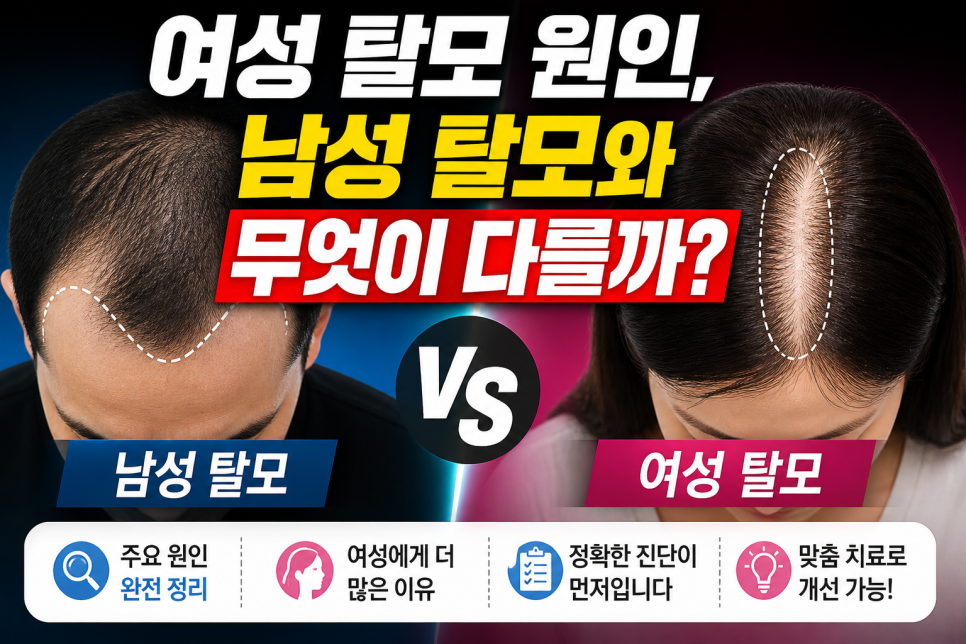
여성 탈모 원인, 남성 탈모와 무엇이 다를까?
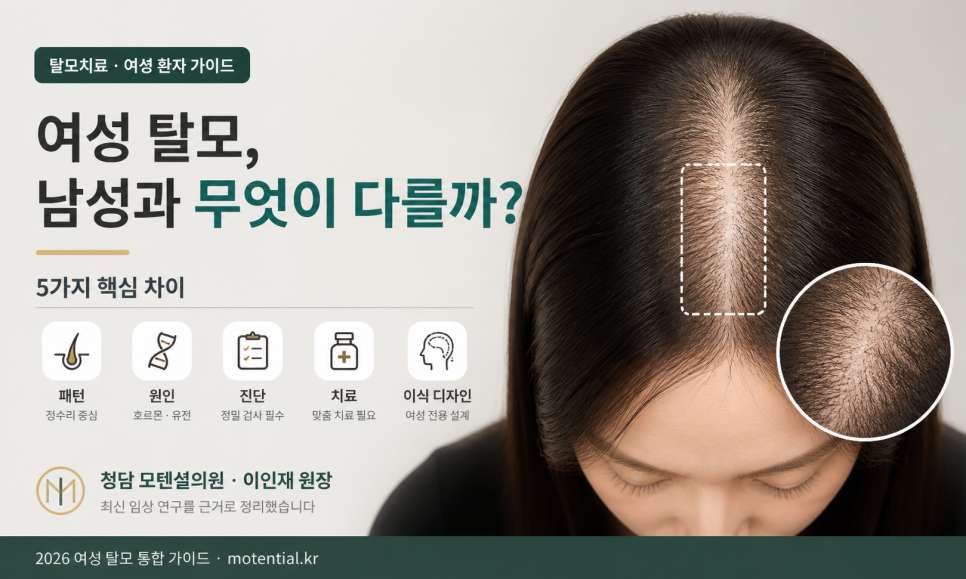
안녕하세요, 청담 모텐셜의원 이인재 원장입니다.
최근 방송 출연을 할 때마다 매번 주제가 같았습니다.
놀랍게도 ‘여성탈모’ 였는데요, 과거엔 탈모 라고 하면 남자들만의 고민으로 알려졌었죠.
하지만 지금은 정말 많은 여성분들이 여성형 탈모로 고민 중이십니다.
“원장님, 가르마가 점점 넓어져요. 거울 보기가 무서워졌어요.”
“인터넷 찾아보면 전부 남성 탈모 치료 이야기 뿐이에요.”
마지막 환자분 말씀이 오늘 글의 출발점입니다. 인터넷에 떠도는 탈모 정보의 90% 이상이 남성 탈모를 기준으로 쓰여 있고, 그 정보를 그대로 여성 탈모에 적용하면 잘못된 진단과 잘못된 치료로 이어지는 경우가 정말 많습니다.
여성 탈모는 남성 탈모와 결정적으로 다른 다섯 가지 특징이 있습니다. 오늘은 그 차이를 진료실에서 환자분께 설명드리는 그대로 정리해 드리겠습니다.
1. 패턴이 다릅니다 — M자가 아니라 ‘가르마 확장’
남성 탈모를 떠올리면 보통 두 가지 이미지가 떠오르죠. 이마 라인이 후퇴하는 M자, 그리고 정수리부터 동그랗게 비어가는패턴입니다.
여성 탈모는 다릅니다. 가장 전형적인 패턴은 가르마 라인이 천천히 넓어지는 형태입니다. 의학적으로는 Ludwig 분류라고 부르며, 1단계부터 3단계로 진행됩니다 [1]. 두피가 하얗게 비춰보이는 부분이 크리스마스 트리처럼 넓어진다고 보기도 합니다. 이마 헤어라인은 비교적 잘 보존되지만, 머리카락이 얇아지면서 가르마를 중심으로 좌우로 점점 넓어지는 양상이 일반적입니다.

이 차이가 왜 중요할까요? 환자분들이 본인 탈모를 알아차리는 시점이 늦어지기 때문입니다. M자처럼 명확한 라인 변화가 있으면 빨리 인지하지만, 가르마는 매일 거울을 봐도 변화가 천천히 누적돼서 “어느 날 사진 보고 깜짝 놀라는” 케이스가 정말 많습니다.
또 한 가지, 여성 탈모는 ‘광범위한 비치는 느낌’으로 진행되는 경우도 많습니다. 모발이 통째로 빠지기보다는 한 올 한 올의 굵기가 얇아지면서 두피가 비쳐 보이는 형태입니다.
2. 원인이 다릅니다 — DHT 단독이 아닌 ‘다인성’
남성형 탈모에선 대표적인 원인이 한가지 있습니다.
디하이드로테스토스테론(DHT)이라는 호르몬이 모낭을 공격하는 안드로겐성 탈모죠. 그래서 치료도 DHT를 차단하는 약(피나스테리드, 두타스테리드)이 핵심입니다.
여성 탈모는 다릅니다. 원인이 한 가지가 아니라 여러 가지가 동시에 작용합니다. 진료실에서 가장 자주 만나는 원인을 정리해 드리면 다음과 같습니다.
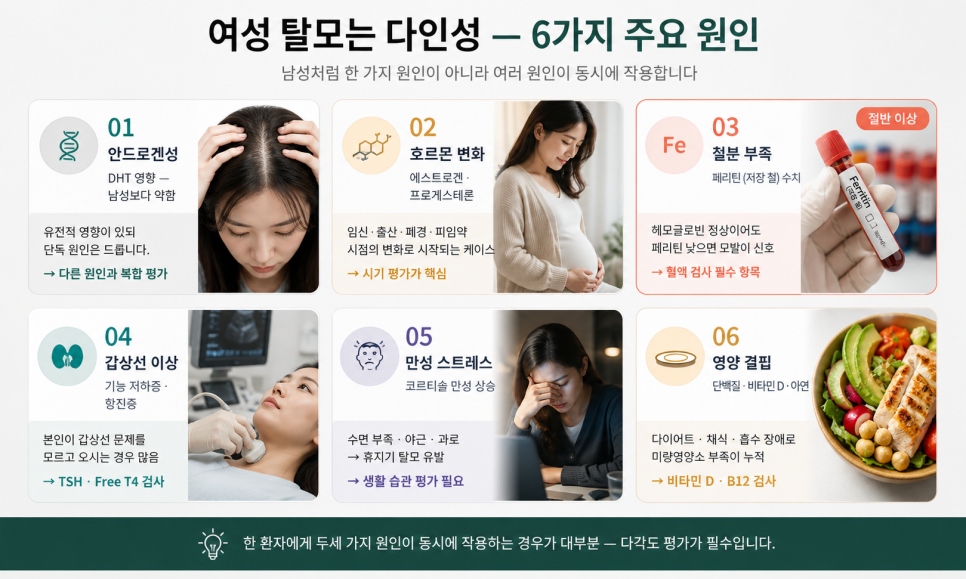
첫째, 안드로겐성 탈모. 여성에게도 DHT 영향은 있지만 남성보다 약합니다.
둘째, 여성 호르몬의 변화 입니다. 임신, 출산 직후, 폐경 전후, 그리고 피임약 복용·중단 시점에 탈모가 시작되는 케이스가 정말 많습니다.
셋째, 철분 부족. 생각보다 많은 여성 탈모 환자분들이 페리틴(저장 철) 수치가 낮습니다. 일반 적혈구 수치(헤모글로빈)는 정상이어도 페리틴이 낮으면 모발이 가장 먼저 신호를 보냅니다 [2,3].
넷째, 갑상선 기능 이상. 갑상선 기능 저하증 또는 항진증 모두 탈모를 유발합니다 [4]. 의외로 본인이 갑상선 문제가 있는 줄 모르고 오시는 분이 많습니다.
다섯째, 만성 스트레스. 휴지기 탈모의 원인이 될 수 있습니다.
여섯째, 영양 결핍. 다이어트, 채식, 단백질 부족, 비타민 D·B12·아연 부족 등이 모두 영향을 줍니다.
이 여러 원인이 한 환자에게 두세 가지 동시에 작용하는 경우가 대부분입니다. 그래서 여성 탈모는 원인을 다각도로 평가하고 그 원인 각각에 맞는 치료를 동시에 진행해야 합니다.
3. 진단 방법이 다릅니다 — 혈액검사가 필요 할 수 있습니다.
남성 탈모는 두피 검사와 가족력 청취만으로도 어느 정도 진단이 가능합니다. 안드로겐성 탈모가 압도적으로 많기 때문이죠.
여성 탈모는 두피 검사만으로는 부족할 수 있습니다. 물론 간단한 검사와 문진만으로도 확인이 가능한 경우도 있고, 실제로 많은 환자분들은 주기적인 건강검진을 통해 자신의 기저질환 혹은 부족한 결핍에 대해서도 잘 알고 계시는 경우가 많습니다.
다만 좀 더 명확한 확인이 필요한 경우, 정확한 치료를 위한 다인성 원인을 가려내려면 혈액 검사가 필수입니다. 진료실에서 여성 탈모 환자분께 기본으로 권하는 검사는 다음과 같습니다.
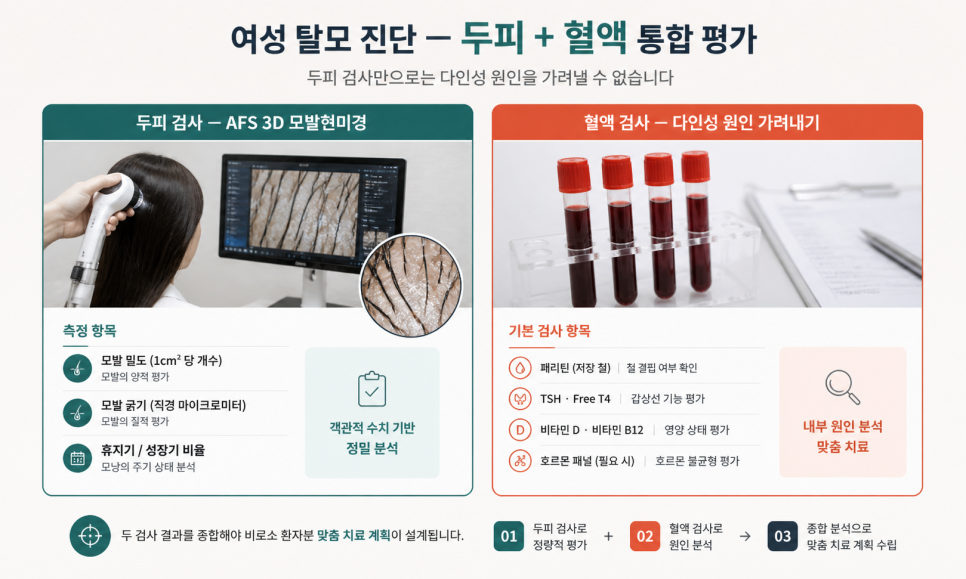
페리틴(저장 철), TSH·Free T4(갑상선), 비타민 D, 비타민 B12, 그리고 필요에 따라 호르몬 패널(에스트로겐, 프로게스테론, 테스토스테론, DHEA-S, 프로락틴), 인슐린 저항성 지표 등을 추가로 봅니다.
그리고 두피 모낭의 상태도 정량적으로 측정합니다. 모낭의 밀도, 굵기, 휴지기·성장기 비율을 AFS 3D 모발현미경으로 확인하면 현재 어느 단계인지 객관적인 수치로 평가가 가능합니다.
이 검사 결과가 나와야 비로소 “이 환자분은 철분 부족 + 갑상선 경계 + 약한 안드로겐성 영향이 함께 있는 케이스”라는 식의 통합적 진단이 나오고, 그에 맞는 맞춤 치료 계획이 설계됩니다.
4. 치료 옵션이 다릅니다 — 피나스테리드는 절대 금기
여성 탈모 치료에서 가장 자주 받는 질문이 이것입니다.
“원장님, 그럼 저도 프로페시아(피나스테리드) 먹으면 되나요?”
답은 명확히 “안 됩니다”입니다. 이유는 두 가지입니다.
첫째, 가임기 여성이 피나스테리드나 두타스테리드를 복용하면 임신 시 태아의 외부 생식기 발달에 영향을 줄 수 있어 절대 금기입니다 [5].
둘째, 폐경 후 여성에게 사용한 일부 연구가 있긴 하지만, 효과가 남성만큼 뚜렷하지 않고 부작용 대비 이익이 명확하지 않은 경우가 많습니다 [6].
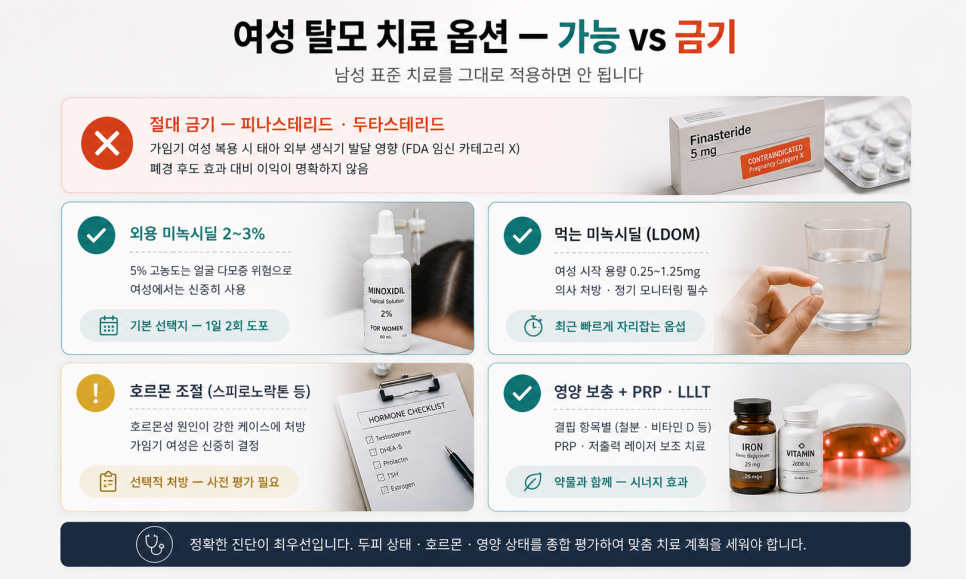
그렇다면 여성 탈모 치료는 어떻게 진행할까요? 진료실에서 환자분 상태에 따라 조합하는 옵션은 다음과 같습니다.
먼저 외용 미녹시딜. 여성은 보통 2% 또는 3% 농도부터 시작합니다. 5% 고농도는 얼굴 다모증 위험이 더 높아서 신중히 사용합니다 [7].
다음으로 저용량 경구 미녹시딜(LDOM). 최근 몇 년 사이 여성 탈모 치료에 빠르게 자리잡고 있는 옵션입니다. 0.25mg에서 1.25mg 정도의 매우 낮은 용량으로 시작하며, 의사 처방·관리가 필수입니다 [8,9].
호르몬 조절 치료. 스피로노락톤, 사이프로테론 등 항안드로겐 효과가 있는 약을 호르몬성 원인이 강할 때 처방합니다 [10]. 이는 가임기 여성에게는 신중히 결정해야 합니다.
원인별 영양 보충. 페리틴이 낮으면 철분, 비타민 D 부족이면 비타민 D, 갑상선 문제면 갑상선 치료를 동시에 진행합니다. 탈모약만 먹는 것이 아니라 ‘결핍을 채우는’ 치료가 함께 가야 효과가 나옵니다.
PRP·저출력 레이저(LLLT) 등 보조 치료. 약물에 알레르기가 있거나 약 외 옵션을 원하시는 분께 추가로 권장합니다.
마무리 — 여성 탈모는 ‘맞춤형 통합 치료’가 정답입니다
오늘 글을 정리하면 이렇습니다.
남성 탈모에 비해 여성 탈모는 여러 원인이 존재하고, 환자분마다 어느 원인이 가장 강하게 작용하는지가 다르기 때문에, 한가지 치료를 그대로 적용하면 효과가 잘 나오지 않을 수 있습니다.
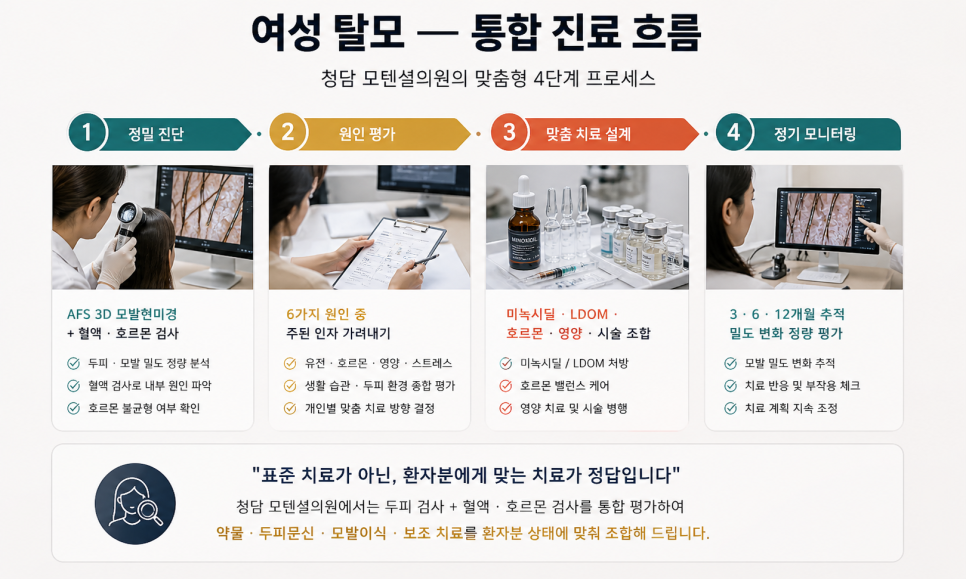
가장 중요한 첫 단계는 정확한 진단입니다. 두피 모낭 검사 + 혈액·호르몬 검사 + 생활 패턴 평가까지 종합해서 본인에게 가장 강하게 작용하는 원인이 무엇인지 가려내야 합니다. 그 결과에 맞춰 조합하는 것이 여성 탈모 치료의 정답입니다.
청담 모텐셜의원에서는 여성 탈모 환자분께 AFS 3D 모발현미경 정밀 검사와 혈액·호르몬 패널 검사를 함께 진행하고, 그 결과를 토대로 약물 단독 치료, 주사치료, 두피문신, 모발이식, 또는 이들의 조합 중 가장 적합한 방향을 의사가 직접 상담드립니다.
거울 앞에서 가르마가 자꾸 신경 쓰이신다면, 인터넷 검색에 시간을 쓰는 것보다 한 번 정확한 검사를 받아보시는 편이 가장 빠른 길입니다.
오늘 글이 도움이 되셨기를 바랍니다. 더 궁금하신 부분이 있으시면 언제든 진료실에서 편하게 말씀 주세요.
청담 모텐셜의원 이인재 드림.
참고 문헌
[1] Ludwig E. Classification of the types of androgenetic alopecia (common baldness) occurring in the female sex. British Journal of Dermatology. 1977;97(3):247-254.
[2] Park SY, Na SY, Kim JH, Cho S, Lee JH. Iron plays a certain role in patterned hair loss. Journal of Korean Medical Science. 2013;28(6):934-938.
[3] Trost LB, Bergfeld WF, Calogeras E. The diagnosis and treatment of iron deficiency and its potential relationship to hair loss. Journal of the American Academy of Dermatology. 2006;54(5):824-844.
[4] Vincent M, Yogiraj K. A descriptive study of alopecia patterns and their relation to thyroid dysfunction. International Journal of Trichology. 2013;5(1):57-60.
[5] U.S. Food and Drug Administration. PROPECIA (finasteride) and AVODART (dutasteride) Prescribing Information — Pregnancy contraindication (Category X). 2024 update.
[6] Price VH, Roberts JL, Hordinsky M, et al. Lack of efficacy of finasteride in postmenopausal women with androgenetic alopecia. Journal of the American Academy of Dermatology. 2000;43(5 Pt 1):768-776.
[7] Lucky AW, Piacquadio DJ, Ditre CM, et al. A randomized, placebo-controlled trial of 5% and 2% topical minoxidil solutions in the treatment of female pattern hair loss. Journal of the American Academy of Dermatology. 2004;50(4):541-553.
[8] Ramos PM, Sinclair RD, Kasprzak M, Miot HA. Minoxidil 1 mg oral versus minoxidil 5% topical solution for the treatment of female-pattern hair loss: A randomized clinical trial. Journal of the American Academy of Dermatology. 2020;82(1):252-253.
[9] Vañó-Galván S, Pirmez R, Hermosa-Gelbard A, et al. Safety of low-dose oral minoxidil for hair loss: A multicenter study of 1404 patients. Journal of the American Academy of Dermatology. 2021;84(6):1644-1651.
[10] Sinclair R, Wewerinke M, Jolley D. Treatment of female pattern hair loss with oral antiandrogens. British Journal of Dermatology. 2005;152(3):466-473.
[11] van Zuuren EJ, Fedorowicz Z, Schoones J. Interventions for female pattern hair loss. Cochrane Database of Systematic Reviews. 2016;(5):CD007628.
[12] Sinclair RD. Female pattern hair loss: a pilot study investigating combination therapy with low-dose oral minoxidil and spironolactone. International Journal of Dermatology. 2018;57(1):104-109.
본 글은 일반인 환자분의 이해를 돕기 위한 의학 정보이며, 개별 진단·치료의 근거가 되지는 않습니다. 실제 치료는 반드시 진료를 통해 결정됩니다.
女性の薄毛の原因、男性の薄毛と何が違う?
こんにちは、清潭モテンシャル医院のイ・インジェ院長です。
最近、メディア出演のたびに毎回テーマが同じでした。
驚くことに「女性の薄毛」だったのです。かつては薄毛といえば男性だけの悩みと思われていました。
しかし今は、本当に多くの女性が女性型脱毛に悩んでいらっしゃいます。
「院長、分け目がだんだん広がるんです。鏡を見るのが怖くなりました。」「ネットで調べても、全部 男性の薄毛治療の話ばかりです。」
最後の患者さまの言葉が、今日の記事の出発点です。ネットに出回る薄毛情報の90%以上が男性の薄毛を基準に書かれており、その情報をそのまま女性の薄毛に当てはめると、誤った診断・誤った治療につながるケースが本当に多いのです。
女性の薄毛には、男性の薄毛と決定的に異なる五つの特徴があります。今日はその違いを、診察室で患者さまにご説明するそのまま整理してお伝えします。
1. パターンが違う — M字ではなく「分け目の拡大」
男性の薄毛というと、たいてい二つのイメージが浮かびます。額の生え際が後退するM字、そして頭頂部から丸く薄くなっていくパターンです。
女性の薄毛は違います。最も典型的なパターンは、分け目のラインがゆっくり広がっていく形です。医学的にはLudwig分類と呼ばれ、1段階から3段階へ進行します[1]。頭皮が白く透けて見える部分がクリスマスツリーのように広がる、と表現されることもあります。額のヘアラインは比較的よく保たれますが、髪が細くなりながら分け目を中心に左右へ次第に広がっていくのが一般的です。
この違いがなぜ重要なのでしょうか。患者さまがご自身の薄毛に気づく時期が遅れるからです。M字のように明確なライン変化があれば早く気づきますが、分け目は毎日鏡を見ても変化がゆっくり積み重なるため、「ある日、写真を見てはっと驚く」ケースが本当に多いのです。
もう一つ、女性の薄毛は「広い範囲で透けて見える感じ」で進むことも多いです。髪が丸ごと抜けるというより、一本一本の太さが細くなって頭皮が透けて見える形です。
2. 原因が違う — DHT単独ではなく「多因性」
男性型脱毛には、代表的な原因が一つあります。
ジヒドロテストステロン(DHT)というホルモンが毛包を攻撃するアンドロゲン性脱毛です。だから治療もDHTを抑える薬(フィナステリド、デュタステリド)が中心になります。
女性の薄毛は違います。原因が一つではなく、複数が同時に作用します。診察室で最もよく出会う原因を整理すると、次のとおりです。
一つ目、アンドロゲン性脱毛。女性にもDHTの影響はありますが、男性より弱いです。
二つ目、女性ホルモンの変化です。妊娠、出産直後、閉経前後、そしてピルの服用・中止のタイミングで薄毛が始まるケースが本当に多いです。
三つ目、鉄分不足。思いのほか多くの女性の薄毛患者さまが、フェリチン(貯蔵鉄)の値が低いです。一般の赤血球の値(ヘモグロビン)が正常でも、フェリチンが低いと、髪が最初に信号を送ります[2,3]。
四つ目、甲状腺の機能異常。甲状腺機能低下症も亢進症も、いずれも薄毛を引き起こします[4]。意外にも、ご自身に甲状腺の問題があると気づかずに来られる方が多いです。
五つ目、慢性的なストレス。休止期脱毛の原因になり得ます。
六つ目、栄養不足。ダイエット、菜食、たんぱく質不足、ビタミンD・B12・亜鉛の不足などが、いずれも影響します。
これら複数の原因が、一人の患者さまに二つ三つ同時に作用することがほとんどです。だから女性の薄毛は、原因を多角的に評価し、それぞれの原因に合った治療を同時に進める必要があります。
3. 診断方法が違う — 血液検査が必要なことがあります。
男性の薄毛は、頭皮検査と家族歴の聞き取りだけでも、ある程度の診断が可能です。アンドロゲン性脱毛が圧倒的に多いからです。
女性の薄毛は、頭皮検査だけでは不十分なことがあります。もちろん簡単な検査と問診だけで確認できる場合もありますし、実際、多くの患者さまは定期的な健康診断を通じて、ご自身の基礎疾患や不足している栄養についてよくご存じのことも多いです。
ただし、より明確な確認が必要な場合、正確な治療のために多因性の原因を見分けるには、血液検査が欠かせません。診察室で女性の薄毛患者さまに基本としておすすめする検査は、次のとおりです。
フェリチン(貯蔵鉄)、TSH・Free T4(甲状腺)、ビタミンD、ビタミンB12、そして必要に応じてホルモンパネル(エストロゲン、プロゲステロン、テストステロン、DHEA-S、プロラクチン)、インスリン抵抗性の指標などを追加で確認します。
そして頭皮の毛包の状態も定量的に測定します。毛包の密度、太さ、休止期・成長期の比率をAFS 3D毛髪顕微鏡で確認すれば、今どの段階かを客観的な数値で評価できます。
これらの検査結果が出てはじめて、「この患者さまは鉄分不足+甲状腺の境界+弱いアンドロゲン性の影響が併存するケース」といった統合的な診断が下せ、それに合ったオーダーメイドの治療計画が設計できます。
4. 治療の選択肢が違う — フィナステリドは絶対禁忌
女性の薄毛治療で最もよく受ける質問がこれです。
「院長、では私もプロペシア(フィナステリド)を飲めばいいですか?」
答えははっきり「いけません」です。理由は二つあります。
一つ目、妊娠可能な年齢の女性がフィナステリドやデュタステリドを服用すると、妊娠時に胎児の外性器の発達に影響を与えるおそれがあり、絶対禁忌です[5]。
二つ目、閉経後の女性に使用した一部の研究はあるものの、効果が男性ほど明確でなく、副作用に対する利益がはっきりしない場合が多いです[6]。
では、女性の薄毛治療はどう進めるのでしょうか。診察室で患者さまの状態に応じて組み合わせる選択肢は、次のとおりです。
まず外用ミノキシジル。女性は通常2%または3%の濃度から始めます。5%の高濃度は顔の多毛症のリスクが高くなるため、慎重に使用します[7]。
次に低用量の経口ミノキシジル(LDOM)。ここ数年で女性の薄毛治療に急速に定着している選択肢です。0.25mgから1.25mgほどの非常に低い用量で始め、医師の処方・管理が必須です[8,9]。
ホルモン調節治療。スピロノラクトン、シプロテロンなど抗アンドロゲン作用のある薬を、ホルモン性の原因が強いときに処方します[10]。これは妊娠可能な年齢の女性には慎重に判断する必要があります。
原因別の栄養補充。フェリチンが低ければ鉄分、ビタミンD不足ならビタミンD、甲状腺に問題があれば甲状腺の治療を同時に進めます。薄毛の薬を飲むだけでなく、「不足を補う」治療が一緒に行われてこそ効果が出ます。
PRP・低出力レーザー(LLLT)などの補助治療。薬にアレルギーがある方や、薬以外の選択肢をご希望の方に追加でおすすめします。
おわりに — 女性の薄毛は「オーダーメイドの統合治療」が正解です
今日の記事をまとめると、こうなります。
男性の薄毛に比べ、女性の薄毛は複数の原因が存在し、患者さまごとにどの原因が最も強く作用するかが異なるため、一つの治療をそのまま当てはめても効果が出にくいことがあります。
最も重要な第一歩は正確な診断です。頭皮の毛包検査+血液・ホルモン検査+生活パターンの評価まで総合して、ご自身に最も強く作用している原因は何かを見分ける必要があります。その結果に合わせて組み合わせることが、女性の薄毛治療の正解です。
清潭モテンシャル医院では、女性の薄毛患者さまにAFS 3D毛髪顕微鏡の精密検査と血液・ホルモンパネル検査を併せて行い、その結果をもとに、薬物単独治療、注射治療、頭皮文身、植毛、またはこれらの組み合わせの中から、最も適した方向を医師が直接ご相談します。
鏡の前で分け目がどうしても気になるなら、ネット検索に時間を使うより、一度正確な検査を受けてみるのが一番の近道です。
今日の記事がお役に立てば幸いです。さらに気になる点があれば、いつでも診察室でお気軽にお話しください。
清潭モテンシャル医院 イ・インジェ 拝
参考文献
[1] Ludwig E. Classification of the types of androgenetic alopecia (common baldness) occurring in the female sex. British Journal of Dermatology. 1977;97(3):247-254.
[2] Park SY, Na SY, Kim JH, Cho S, Lee JH. Iron plays a certain role in patterned hair loss. Journal of Korean Medical Science. 2013;28(6):934-938.
[3] Trost LB, Bergfeld WF, Calogeras E. The diagnosis and treatment of iron deficiency and its potential relationship to hair loss. Journal of the American Academy of Dermatology. 2006;54(5):824-844.
[4] Vincent M, Yogiraj K. A descriptive study of alopecia patterns and their relation to thyroid dysfunction. International Journal of Trichology. 2013;5(1):57-60.
[5] U.S. Food and Drug Administration. PROPECIA (finasteride) and AVODART (dutasteride) Prescribing Information — Pregnancy contraindication (Category X). 2024 update.
[6] Price VH, Roberts JL, Hordinsky M, et al. Lack of efficacy of finasteride in postmenopausal women with androgenetic alopecia. Journal of the American Academy of Dermatology. 2000;43(5 Pt 1):768-776.
[7] Lucky AW, Piacquadio DJ, Ditre CM, et al. A randomized, placebo-controlled trial of 5% and 2% topical minoxidil solutions in the treatment of female pattern hair loss. Journal of the American Academy of Dermatology. 2004;50(4):541-553.
[8] Ramos PM, Sinclair RD, Kasprzak M, Miot HA. Minoxidil 1 mg oral versus minoxidil 5% topical solution for the treatment of female-pattern hair loss: A randomized clinical trial. Journal of the American Academy of Dermatology. 2020;82(1):252-253.
[9] Vañó-Galván S, Pirmez R, Hermosa-Gelbard A, et al. Safety of low-dose oral minoxidil for hair loss: A multicenter study of 1404 patients. Journal of the American Academy of Dermatology. 2021;84(6):1644-1651.
[10] Sinclair R, Wewerinke M, Jolley D. Treatment of female pattern hair loss with oral antiandrogens. British Journal of Dermatology. 2005;152(3):466-473.
[11] van Zuuren EJ, Fedorowicz Z, Schoones J. Interventions for female pattern hair loss. Cochrane Database of Systematic Reviews. 2016;(5):CD007628.
[12] Sinclair RD. Female pattern hair loss: a pilot study investigating combination therapy with low-dose oral minoxidil and spironolactone. International Journal of Dermatology. 2018;57(1):104-109.
本記事は一般の患者さまの理解を助けるための医学情報であり、個別の診断・治療の根拠となるものではありません。実際の治療は必ず診察を通じて決定されます。
Causes of Female Hair Loss: How Does It Differ from Male Hair Loss?
Hello, I am Dr. Injae Lee, head doctor of Motential Clinic in Cheongdam.
Recently, every time I appeared on broadcasts, the topic was the same.
Surprisingly it was female hair loss. In the past, hair loss was known as a worry for men only.
But now, truly many women are struggling with female-pattern hair loss.
“Doctor, my part keeps getting wider. I’ve become afraid to look in the mirror.” “When I search online, it’s all about male hair-loss treatment.”
That last patient’s remark is the starting point of today’s article. Over 90% of the hair-loss information floating around online is written based on male hair loss, and applying that information directly to female hair loss really often leads to wrong diagnosis and wrong treatment.
Female hair loss has five features that are decisively different from male hair loss. Today I will lay out those differences exactly as I explain them to patients in the clinic.
1. The pattern is different — not an M-shape but “part widening”
When you think of male hair loss, two images usually come to mind: the M-shape where the forehead line recedes, and the pattern where the crown empties out in a circle.
Female hair loss is different. The most typical pattern is the form where the part line slowly widens. Medically it is called the Ludwig classification, and it progresses from stage 1 to stage 3 [1]. Some see the area where the scalp shows through white as widening like a Christmas tree. The forehead hairline is relatively well preserved, but as the hair thins, the general pattern is a gradual widening left and right centered on the part.
Why does this difference matter? Because the point at which patients notice their own hair loss is delayed. With a clear line change like an M-shape, people recognize it quickly, but with the part, change accumulates slowly even when looking in the mirror every day, so there really are many cases of “one day being shocked by a photo.”
One more thing: female hair loss often progresses as a “broadly see-through feeling.” Rather than hair falling out entirely, each strand thins so the scalp shows through.
2. The cause is different — not DHT alone but “multifactorial”
In male-pattern hair loss there is one representative cause.
It is androgenetic alopecia, in which a hormone called dihydrotestosterone (DHT) attacks the follicles. So the core of treatment is a drug that blocks DHT (finasteride, dutasteride).
Female hair loss is different. The cause is not one thing but several acting at the same time. Here are the causes I meet most often in the clinic.
First, androgenetic alopecia. Women are also affected by DHT, but more weakly than men.
Second, changes in female hormones. There really are many cases where hair loss begins during pregnancy, right after childbirth, around menopause, and at the time of starting or stopping birth-control pills.
Third, iron deficiency. More female hair-loss patients than you might think have low ferritin (stored iron). Even if the ordinary red-blood-cell value (hemoglobin) is normal, when ferritin is low the hair sends the first signal [2,3].
Fourth, thyroid dysfunction. Both hypothyroidism and hyperthyroidism cause hair loss [4]. Surprisingly many people come in without knowing they have a thyroid problem.
Fifth, chronic stress. It can be a cause of telogen effluvium.
Sixth, nutritional deficiency. Dieting, vegetarianism, protein deficiency, and deficiency of vitamin D, B12, and zinc all have an effect.
In most cases two or three of these causes act on a single patient at once. That is why female hair loss must be evaluated from multiple angles, and treatment tailored to each cause must be carried out at the same time.
3. The diagnostic method is different — a blood test may be needed.
Male hair loss can be diagnosed to some extent with just a scalp exam and a family-history interview, because androgenetic alopecia is overwhelmingly common.
Female hair loss may not be enough with a scalp exam alone. Of course there are cases confirmable with simple testing and an interview, and in fact many patients are well aware of their underlying conditions or deficiencies through regular checkups.
However, when clearer confirmation is needed, a blood test is essential to distinguish the multifactorial causes for accurate treatment. The tests I recommend as a baseline for female hair-loss patients in the clinic are as follows.
Ferritin (stored iron), TSH and Free T4 (thyroid), vitamin D, vitamin B12, and, as needed, a hormone panel (estrogen, progesterone, testosterone, DHEA-S, prolactin) and markers of insulin resistance are additionally examined.
We also quantitatively measure the state of the scalp follicles. Checking follicle density, thickness, and the resting-to-growth phase ratio with the AFS 3D hair microscope allows an objective, numerical assessment of what stage you are currently in.
Only when these test results come out can an integrated diagnosis emerge — for example, “this patient is a case with iron deficiency + borderline thyroid + weak androgenetic influence together” — and a tailored treatment plan be designed accordingly.
4. The treatment options are different — finasteride is absolutely contraindicated
This is the question I get most often in female hair-loss treatment.
“Doctor, so can I take Propecia (finasteride) too?”
The answer is clearly “No.” There are two reasons.
First, if a woman of childbearing age takes finasteride or dutasteride, it can affect the development of a male fetus’s external genitalia during pregnancy, so it is absolutely contraindicated [5].
Second, although there are some studies using it in post-menopausal women, the effect is often not as clear as in men, and the benefit relative to side effects is often unclear [6].
So how is female hair-loss treatment carried out? The options I combine in the clinic depending on the patient’s condition are as follows.
First, topical minoxidil. Women usually start from a 2% or 3% concentration. The high 5% concentration carries a higher risk of facial hypertrichosis, so it is used cautiously [7].
Next, low-dose oral minoxidil (LDOM). It is an option that has been rapidly establishing itself in female hair-loss treatment in recent years. It starts at a very low dose of about 0.25 mg to 1.25 mg, and a doctor’s prescription and management are essential [8,9].
Hormone-regulating treatment. Anti-androgen drugs such as spironolactone and cyproterone are prescribed when a hormonal cause is strong [10]. This must be decided cautiously for women of childbearing age.
Cause-specific nutritional supplementation. If ferritin is low, iron; if vitamin D is deficient, vitamin D; if there is a thyroid problem, thyroid treatment is carried out at the same time. Not just taking a hair-loss drug but a treatment that “fills the deficiency” must go together for the effect to show.
Adjunctive treatments such as PRP and low-level laser therapy (LLLT). These are additionally recommended for those allergic to medication or who want options beyond drugs.
In closing — for female hair loss, “tailored integrated treatment” is the answer
To sum up today’s article:
Compared with male hair loss, female hair loss has multiple causes, and which cause acts most strongly differs from patient to patient, so applying a single treatment as-is may not work well.
The most important first step is accurate diagnosis. You must comprehensively combine a scalp-follicle exam + blood and hormone tests + lifestyle assessment to distinguish which cause acts most strongly on you. Combining treatment according to those results is the answer for female hair loss.
At Motential Clinic in Cheongdam, we carry out AFS 3D hair-microscope precision testing together with blood and hormone-panel testing for female hair-loss patients, and based on the results a doctor personally advises the most suitable direction among drug-only treatment, injection treatment, scalp micropigmentation, hair transplant, or a combination of these.
If your part keeps bothering you in front of the mirror, getting an accurate test once is the fastest path, rather than spending time on internet searches.
I hope today’s article was helpful. If you have more questions, please feel free to ask any time in the consultation room.
From Dr. Injae Lee, Motential Clinic, Cheongdam.
References
[1] Ludwig E. Classification of the types of androgenetic alopecia (common baldness) occurring in the female sex. British Journal of Dermatology. 1977;97(3):247-254.
[2] Park SY, Na SY, Kim JH, Cho S, Lee JH. Iron plays a certain role in patterned hair loss. Journal of Korean Medical Science. 2013;28(6):934-938.
[3] Trost LB, Bergfeld WF, Calogeras E. The diagnosis and treatment of iron deficiency and its potential relationship to hair loss. Journal of the American Academy of Dermatology. 2006;54(5):824-844.
[4] Vincent M, Yogiraj K. A descriptive study of alopecia patterns and their relation to thyroid dysfunction. International Journal of Trichology. 2013;5(1):57-60.
[5] U.S. Food and Drug Administration. PROPECIA (finasteride) and AVODART (dutasteride) Prescribing Information — Pregnancy contraindication (Category X). 2024 update.
[6] Price VH, Roberts JL, Hordinsky M, et al. Lack of efficacy of finasteride in postmenopausal women with androgenetic alopecia. Journal of the American Academy of Dermatology. 2000;43(5 Pt 1):768-776.
[7] Lucky AW, Piacquadio DJ, Ditre CM, et al. A randomized, placebo-controlled trial of 5% and 2% topical minoxidil solutions in the treatment of female pattern hair loss. Journal of the American Academy of Dermatology. 2004;50(4):541-553.
[8] Ramos PM, Sinclair RD, Kasprzak M, Miot HA. Minoxidil 1 mg oral versus minoxidil 5% topical solution for the treatment of female-pattern hair loss: A randomized clinical trial. Journal of the American Academy of Dermatology. 2020;82(1):252-253.
[9] Vañó-Galván S, Pirmez R, Hermosa-Gelbard A, et al. Safety of low-dose oral minoxidil for hair loss: A multicenter study of 1404 patients. Journal of the American Academy of Dermatology. 2021;84(6):1644-1651.
[10] Sinclair R, Wewerinke M, Jolley D. Treatment of female pattern hair loss with oral antiandrogens. British Journal of Dermatology. 2005;152(3):466-473.
[11] van Zuuren EJ, Fedorowicz Z, Schoones J. Interventions for female pattern hair loss. Cochrane Database of Systematic Reviews. 2016;(5):CD007628.
[12] Sinclair RD. Female pattern hair loss: a pilot study investigating combination therapy with low-dose oral minoxidil and spironolactone. International Journal of Dermatology. 2018;57(1):104-109.
This article is medical information to aid the understanding of general patients and does not serve as the basis for individual diagnosis or treatment. Actual treatment is always determined through consultation.